
The Accidental Reader: Lessons from an Unlikely Intellectual Journey
Intention, Writing, Intellectual Discipline


I’m often asked on X (formerly Twitter) to share “tips” about reading.
While I appreciate the compliment (since it implies that some people find my intellectual trajectory or habits worthy of imitation) I also find the question interesting for another reason: my relationship with reading developed relatively late.
In other words, I am not someone who grew up as a precocious or naturally bookish reader, and this is the part that can be instructive for many.
From the standpoint of reading ability and interest, I was not even average as a child; if anything, I was below average. Even the children’s books or the novels assigned at school were difficult for me to finish. Reading felt more like a chore than a source of curiosity or pleasure. I remember, for instance, that my younger brother (who is now an emergency physician) used to read the Goosebumps horror series, a very popular set of children’s books.
At the time, I mocked him for it, dismissing his enthusiasm as “pseudo-intellectualism,” when in reality his behavior was simply normal: he was reading as most pre-teens do, whereas I largely avoided it and, retrospectively, I won’t even blame my socioeconomic background (first generation immigrant with roots in Azad Kashmir, in rural Pakistan), as my own brother is a counter-example.
However, this whole situation changed rather abruptly in the early 2000s when I became active on Jeuxvideo.com, which remains France’s largest online forum dedicated to video games. Initially, my participation had nothing to do with intellectual ambition. Like many pre-teens and teens of that period, I joined primarily to discuss video games, series such as The Legend of Zelda, Metal Gear Solid, and Resident Evil, which were among my favorites.
Yet participating in online discussions had an unexpected effect. Forums required writing, argumentation, and the ability to articulate opinions in a public space where others could respond, challenge, or critique them.
This alone marks an important difference with the way Generation Z has been socialized online: whereas earlier internet spaces, such as forums, encouraged relatively long-form writing, argumentation, and sustained discussion, contemporary platforms tend to prioritize short, highly reactive content optimized for visibility and engagement.
In practice, this often means interaction structured around algorithmic reach and rapid dopamine-driven feedback rather than extended reasoning or deliberation.
Gradually, this environment forced me to structure my thoughts and express them more clearly. What began as casual participation in gaming discussions slowly became a training ground for written expression and critical reflection.
To illustrate this early stage, here is a short excerpt from something I wrote in April 2004. I had just turned 13 and attempted a kind of review of the video game SoulCalibur II on the GameCube (with a translation from the French below):
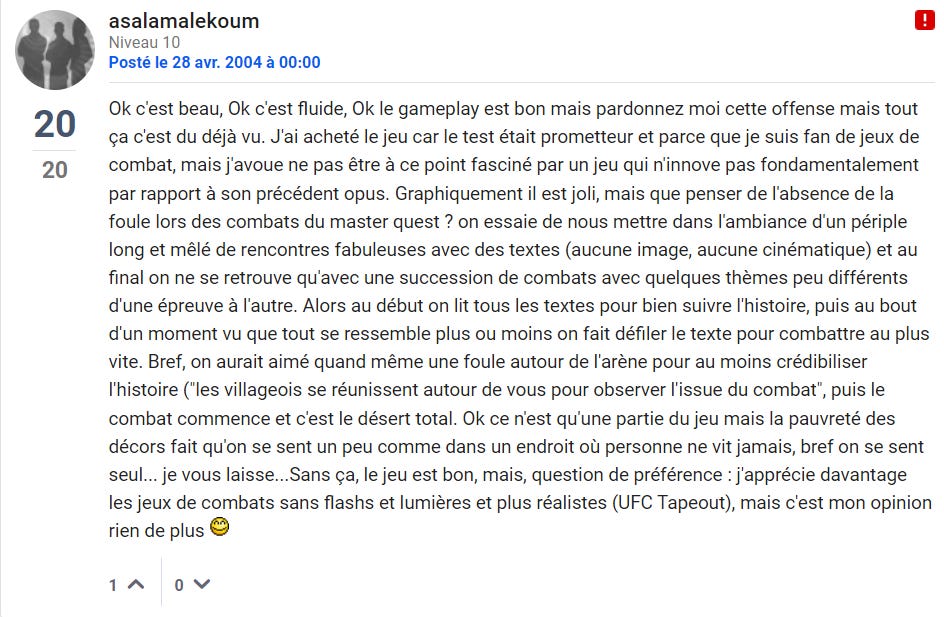
Ok it’s beautiful, ok it’s smooth, ok the gameplay is good, but forgive this offense, everything here feels like déjà vu. I bought the game because the review was promising and because I’m a fan of fighting games, but I admit I’m not that fascinated by a game that doesn’t fundamentally innovate compared to its previous installment.
Graphically it’s nice, but what about the absence of a crowd during the Master Quest fights? We’re supposed to be immersed in the atmosphere of a long journey mixed with fabulous encounters described through text (no images, no cutscenes), and in the end we only get a succession of fights with a few themes that differ slightly from one challenge to another.
At first we read all the text to follow the story properly, but after a while, since everything more or less looks the same, we just scroll through the text to get to the fights as quickly as possible. In short, we would have liked at least a crowd around the arena to make the story more believable (“the villagers gather around you to watch the outcome of the fight”), and then the fight begins… but it’s a total desert.
Ok, it’s only one part of the game, but the poverty of the environments makes you feel like you’re in a place where no one ever lives - basically you feel alone… I’ll leave it there. Without that, the game is good, but as a matter of preference I like fighting games without flashy lights and effects and that are more realistic (UFC Tapout), but that’s just my opinion, nothing more. 😁
Two elements can already be observed in this early example. First, my username at the time, “asalamalekoum,” created one or two years earlier, already reflected an interest in Islam. Second, even at that age I tended to write relatively long posts and, if one reads the original French, the syntax and grammar were already fairly structured.
This leads to a brief autobiographical digression, not because the anecdote itself is important, but because it illustrates the two main factors that ultimately shaped my reading habits and intellectual development: Islam and writing.
Islam
The first factor was Islam. In the geopolitical context following the Iraq War, I encountered a number of individuals who were critical of Islam, generally in a polite but intellectually serious way. I remember, for instance, two members of the Baha’i faith (a community that is extremely rare in France) who mobilized a wide range of arguments and references in their critiques. Through these interactions I encountered, often for the first time, words and concepts such as sociology, epistemology, or anthropology. These were disciplines I had never previously heard of.
Faced with this situation, I reacted in a way that, in retrospect, shaped my entire intellectual trajectory. Despite being someone who had struggled even to finish children’s books, I made a personal commitment to read as broadly as possible in order to better understand and defend my religious tradition. This meant gradually exploring philosophy, anthropology, history, and other fields of knowledge.
What is important here is the underlying motivation. My intellectual development was not initially driven by academic prestige, social recognition, or any form of worldly ambition. Rather, it was driven by niyyah (intention) as understood in the Islamic tradition: the idea that actions derive their value from the sincerity of the intention behind them.
From that perspective, I see my later intellectual progress less as a personal achievement than as something made possible through sincere intention, for which I believe Allah has been generous with me.
Writing
The second major factor was writing. From an early age I made a deliberate effort to write carefully, paying attention to grammar, syntax, and vocabulary. Participating in forums required articulating arguments, responding to others, and structuring thoughts in a coherent way. This repeated practice of writing relatively long and analytical posts functioned as a kind of informal training.
There is also a deeper cognitive connection here: writing and reading are not independent skills; they reinforce each other. Producing structured writing forces the mind to organize ideas, maintain logical coherence, and sustain attention over extended sequences of language; these same cognitive capacities (working memory, linguistic processing, and conceptual structuring) are precisely those required for reading complex texts. In other words, practicing analytical writing can significantly facilitate the ability to engage with dense and demanding books (more on this below).
In my case, the habit of writing long and relatively structured texts from an early age gradually made it easier to approach and finish long and intellectually demanding works.
Advice
My advice, therefore, is relatively simple, though its implications are deeper than they might first appear.
First, purify your intention (niyyah). This is the most important point. Intellectual development that is driven primarily by status, recognition, or social competition tends to be fragile and inconsistent. By contrast, when learning is anchored in a sincere intention it becomes more stable and disciplined. In Islamic thought, niyyah gives coherence and direction to action; it transforms what might otherwise be a scattered pursuit of information into a meaningful and sustained effort toward understanding.
Second, cultivate the habit of writing regularly. Try to write long messages, reflective posts, or even short essays about subjects that interest you. Treat this as a daily or near-daily exercise. As I said before, writing functions as a powerful training mechanism for the mind. When you write analytically, several mental processes are activated simultaneously: working memory, semantic retrieval, syntactic structuring, and logical sequencing.
In order to express an idea clearly, the brain must organize concepts hierarchically, select precise vocabulary, and maintain coherence across sentences and paragraphs. These processes engage neural networks in the prefrontal cortex that are associated with executive function, particularly planning, cognitive control, and sustained attention.
This is one reason why writing tends to reinforce reading ability. Both activities rely on overlapping cognitive systems involved in language processing and conceptual organization. When someone practices structured writing regularly, they train their brain to process complex linguistic material more efficiently. As a result, dense or abstract texts become easier to navigate because the reader has already internalized many of the same structures required to produce such texts.
There is also a psychological dimension. Writing forces a form of “active cognition.” Instead of passively absorbing information, the writer must reformulate, reinterpret, and sometimes challenge ideas. This process strengthens comprehension and memory through what cognitive scientists sometimes call generative processing: the act of producing language helps consolidate knowledge more effectively than merely consuming it.
For these reasons, writing can function as a kind of intellectual gymnasium. Just as physical exercise strengthens muscles through repeated strain and adaptation, regular writing strengthens the cognitive capacities necessary for sustained reading and complex reasoning.
In short: purify your intention, and train your mind through writing. Over time, the ability to read difficult and demanding works will follow naturally.
As for reading itself, my approach was somewhat unconventional. Rather than starting with introductory or simplified books, I tended to search for canonical reading list, for example, lists of the ten most important works in philosophy, or similar rankings in other disciplines. My reasoning was that introductory texts, while useful in certain contexts, often risk keeping the reader in a passive position. They simplify arguments, remove conceptual difficulty, and therefore do not always force the reader to develop the cognitive endurance required for engaging with complex works.
By contrast, approaching foundational or “classic” texts directly, even when they are difficult, functions as a form of intellectual training. At the beginning this was extremely challenging. My reading pace was slow; sometimes I could only manage fifty pages in an entire month. Much of the time was spent rereading passages, looking up unfamiliar terms, or simply trying to grasp the structure of the argument.
However, this difficulty was itself part of the process. Cognitive effort, especially when sustained over time, gradually increases one’s capacity to process complex information. Over the years, my reading speed and comprehension improved significantly. At my peak, during my early twenties in the early 2010s, a period when I had relatively few professional or personal responsibilities I was sometimes able to read two (even three) books per week. This is not particularly extraordinary in itself, but it reflected a certain level of intellectual discipline and consistency, especially considering my starting point.
It is also worth noting that I tried to remain selective in what I read. Rather than consuming books indiscriminately, I focused on works that had historically shaped major fields of thought (philosophy, anthropology, sociology, and related disciplines.)
This is essentially all I have to say. If anything, the length of this explanation probably illustrates the very point I have been making: over the years I have developed a natural affinity for long-form writing.
In fact, 2026 marks exactly twenty years since I began this intellectual “adventure”, in 2006.
The Qur’an repeatedly evokes the transformation of night into day and day into night, a metaphor for the divine capacity to alter states and conditions; in that sense, even personal dispositions are not immutable: Allah can turn someone who once avoided books into someone devoted to reading.
As a form of conclusion, by 2008, when I was 17, I had already acquired a basic familiarity with metaphysical debates, citing thinkers whose names would have been completely unknown to me just two or three years before (this was in the context of Akbarian ontology being “pantheism”):
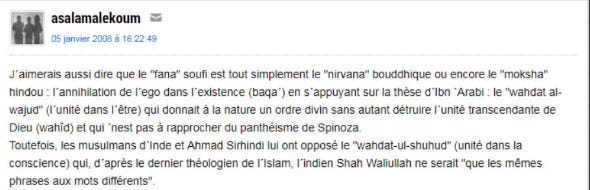
(…) the annihilation of the ego within existence (baqa’), drawing on Ibn ʿArabi’s thesis of wahdat al-wujud (“unity of being”), which endowed nature with a divine order without thereby destroying the transcendent unity of God, and which should not be equated with Spinoza’s pantheism.
However, the Muslims of India, and Ahmad Sirhindi in particular, opposed this with wahdat al-shuhud (“unity in consciousness”), which, according to the later Islamic theologian of India, Shah Waliullah, would be “nothing more than the same phrases expressed with different words”.
❤️❤️❤️
May Allah bless you Bheria-sensei.